Manage roads, water, fleet, facilities, and linear assets in one connected system


Citywide Assets helps local governments track, maintain, and improve infrastructure across its full lifecycle. Purpose-built for municipalities, it brings together asset registries, condition assessments, maintenance scheduling, GIS integration, and capital planning — so your teams can connect day-to-day operations with long-term priorities.
Key Outcomes
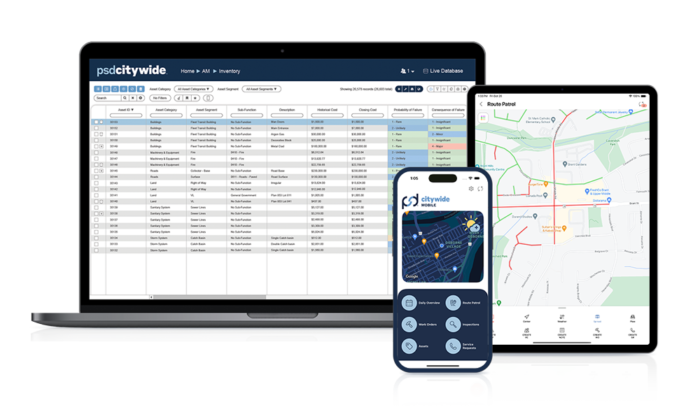
Manage assets, maintenance, inspections, and capital planning in one centralized platform designed for local governments and public works teams.
Remove the guesswork from decision-making. Citywide Decision Support helps you compare scenarios, prioritize risk and performance, and build long-term infrastructure plans.

Remove the guesswork from decision-making. Citywide Decision Support helps you compare scenarios, prioritize risk and performance, and build long-term infrastructure plans.
Enable field teams to collect asset and condition data, capture images, and update attributes online or offline, with changes syncing automatically through the Citywide Mobile app.

Remove the guesswork from decision-making. Citywide Decision Support helps you compare scenarios, prioritize risk and performance, and build long-term infrastructure plans.
Remove guesswork from decision-making. Citywide Decision Support helps you compare scenarios, prioritize risk and performance, and build long-term infrastructure plans.
Enable field teams to collect asset and condition data, capture images, and update attributes online or offline, with changes syncing automatically through the Citywide Mobile app.
Citywide Mobile App



Citywide Assets supports specialized workflows for each department, ensuring every team has the tools they need to succeed.
Manage roads, bridges, sidewalks, and inspections with GIS-centric tracking and condition assessments
Track lifecycle performance and compliance across water, sewer, stormwater, and pump systems
Manage park and conservation area assets, map trails, and track work orders with GIS integration and mobile tools
Support campus asset and facility management with centralized data, lifecycle planning, and integrated budgeting tools
Asset Management
Definition
Focus
Scope
Goal
Activities
Maintenance Management
Definition
Focus
Scope
Goal
Activities
Get our free eBook: Asset Management is More Than Maintenance
Citywide software integrates asset, maintenance, and financial data for better decisions
Proven in real-world municipal environments across North America
Replaces spreadsheets and legacy systems with a flexible solution that grows with your municipality.
Case Study
With Citywide Assets and expert asset management advisory support, the District of Squamish, BC (population: ~20,000) identified and corrected a $15 million overstatement in its asset data, giving staff greater confidence in the accuracy of their financial reporting.

The Infrastructure Investment and Jobs Act provided supplemental DWSRF funding starting in fiscal year 2022. Fiscal year 2027, which began October 1, 2026, is the first year the DWSRF receives no IIJA supplemental funding. The final IIJA lead service line tranche was $3 billion appropriated, of which $2.875 billion was allotted to states in May 2026 after Congress redirected $125 million to wildfire programs.
As of October 2026, fiscal year 2027 funding remains unsettled. A stopgap funding bill (P.L. 119-103) keeps the government funded through December 11, 2026. The House FY2027 bill gives the drinking water fund $910 million, $215 million less than FY2026, while separately drawing $1.03 billion for 1,197 earmarked projects from the same account (CRS IF13177).
Yes, in some cases, but only through specific routes and with state approval. The EPA DWSRF Eligibility Handbook lists database infrastructure or software, such as asset management systems and inventory tracking software, as an eligible large capital equipment purchase. It also lists software and training as project start-up costs within a construction or engineering contract. States can also support developing and implementing community asset management plans under the 15% Local Assistance set-aside, if the state chooses to offer these programs. Each state makes the final decision.
The Lead and Copper Rule Improvements require systems to replace lead pipes within 10 years, with a compliance date of November 1, 2027. The rule also requires systems to keep service line inventories up to date.