The stakes for local governments have never been higher. Facing intense financial reviews and constantly shifting regulations across the US and Canada, compliance is no longer a checklist; it’s the required foundation for public trust and financial stability.
The core problem is that many municipal operations remain stuck in a reactive mode, forced to address compliance issues after costly fines, funding clawbacks, or liability claims have already occurred.
To stop managing crises and start preventing them, expert help is essential. Compliance advisory services are designed to redefine your approach: they shift your municipality from playing defense to proactively building resilience.
Advisory firms achieve this by combining regulatory expertise and research with modern technology. By leveraging specialized platforms like asset management tools, public works software, and municipal permitting systems, they embed compliance directly into daily operations, securing your finances and allowing for efficient governance.
Top Compliance Risks for Local Governments & Municipalities
Advisory services are essential because the consequences of failure can be severe. The greatest compliance risks for local governments stem from core functions involving large amounts of public funds, critical infrastructure, and citizen interaction. When ignored, non-compliance in these areas can trigger substantial funding clawbacks, fines, and reputational damage.
High-risk areas include:
- Financial Integrity & Reporting
Financial compliance is essential for both American and Canadian municipalities, focusing on the proper accounting and use of public funds. Financial compliance is defined by adherence to key standards, including:
- US: Adherence to federal mandates like 2 CFR Part 200 (Uniform Guidance) for grants and ensuring all accounting practices align with the Governmental Accounting Standards Board (GASB) principles
- Canada: Compliance with Public Sector Accounting Board (PSAB) standards for financial reporting and strict management of provincial/federal funding agreements (e.g., Infrastructure Canada programs). Risks for both include incorrect expense tracking and insufficient documentation.
- Infrastructure, Safety, and Environment
Governments must comply with complex regulations (depending on location) that govern public assets. Failure here often leads to operational shutdowns or public safety crises.
- US: Includes environmental reviews under the National Environmental Policy Act (NEPA) and adherence to the Americans with Disabilities Act (ADA) Title II. Non-compliance with the ADA Title II standards for accessibility of public facilities is a significant liability risk.
- Canada: Includes compliance with provincial Municipal Acts (e.g. Ontario) and environmental regulations, such as those governing contaminated sites or excess soil management.
Proactive use of asset management tools is crucial for tracking maintenance schedules and ensuring regulatory adherence across all public infrastructure, creating a defensible record of compliance regardless of your location.
- Permitting, Zoning, and Property Taxes
Regulatory risk arises when processes are inconsistent or financial controls are weak, especially concerning development and public transparency.
- Municipal permitting software enforces local zoning and business laws, acting as a necessary audit trail for property tax collection.
- Data Security and Public Meetings: Cybersecurity is a critical compliance standard. Transparency requires that public proceedings and records be accessible, often governed by laws like the WCAG 2.0 Compliance standard for accessibility.
Compliance Advisor Methods to Close Regulatory Gaps
Compliance advisory firms provide an objective, third-party assessment essential for uncovering blind spots within a municipality’s operations.
Comprehensive Risk Assessment
Advisors map the entire regulatory landscape depending on location, creating a detailed Risk Framework and a Levels of Service Framework that links every compliance obligation to a specific internal control. For any jurisdiction, this means creating a matrix that aligns internal policies against all specific governing legal frameworks (like the provincial Municipal Act or US Uniform Guidance).
For a US county, this means focusing on the 2 CFR Part 200 matrix; for a Canadian city, this means ensuring alignment with the provincial Municipal Act and related by-laws.
Strategic Technology Integration
Advisors then integrate technology to fill the gaps and automate governance:
- Operational Systems: They configure asset management tools to automatically flag infrastructure deficiencies that violate established service levels (e.g., a specific pothole depth or lack of required signage).
- Procedural Enforcement: They help implement municipal permitting software to enforce mandatory documentation checks and inspections before issuance, closing procedural gaps instantly and creating a necessary audit trail.
Continuous Compliance Monitoring for Proactive Risk Management
The regulatory environment is constantly changing, making a “set-it-and-forget-it” approach dangerously outdated. Ongoing regulatory compliance monitoring is essential because it allows leaders to maintain financial integrity and operational accountability in real-time.
Key reasons for continuous monitoring include:
- Real-Time Risk Detection: Integrated systems enable a shift from annual audits to continuous monitoring, which uses automated tools to flag anomalies as they occur, preventing small issues from becoming major compliance failures.
- Dynamic Policy Adaptation: Monitoring ensures internal policies remain aligned with evolving regulatory mandates, minimizing vulnerability.
- Minimizes Damage: Proactively avoiding potential financial costs like funding clawbacks and penalties while preserving public trust and financial integrity.
Proactive monitoring within public works software proves that maintenance is performed to regulatory standards, generating a secure and defensible record against liability claims and regulatory scrutiny.
Strategies to Prevent Legal and Financial Penalties
Advisors use an in-depth strategy focused on process maturity, staff training, and the strategic deployment of modern technology to effectively counter regulatory penalties and legal action.
Strategy A: Strong Internal Controls
Advisors enforce best practices like the separation of duties within financial processes and implement strict controls within operational platforms.
This involves splitting work among multiple people and using technology to watch for errors. For instance, configuring public works software to make sure only certain municipal team members can approve the final expense report while field staff can only log issues. This combination ensures accountability and minimizes financial risk.
Strategy B: Audit-Ready Environment
The final line of defense is a secure, unalterable record. Advisors ensure that all systems, especially asset management tools like Citywide Assets and municipal permitting software like Citywide Permitting, create an audit-ready environment.
For infrastructure, this means the system provides precise historical records of condition assessments and repairs. For development, the software clearly logs every approval step and documentation check, providing immediate, data-backed defense against legal action and regulatory scrutiny.
Strategy C: Culture of Compliance
PSD Citywide advisors can design and deliver training programs specifically tailored to the functionality of your Citywide software systems, which ensures staff understand how to operate the software in a manner that meets regulatory obligations. Trained staff are the first line of defense against compliance errors.
PSD Citywide: Integrated Software Solutions & Advisory Services
By partnering with compliance advisory experts, local governments can leverage purpose-built platforms to make compliance an automated function of daily operations, building a more resilient, financially stable, and publicly trusted organization.
Ready to move beyond reactive compliance? Reach out to us today to learn how our advisory services and integrated software platform can transform your local regulatory obligations into a strategic advantage using modern software solutions.
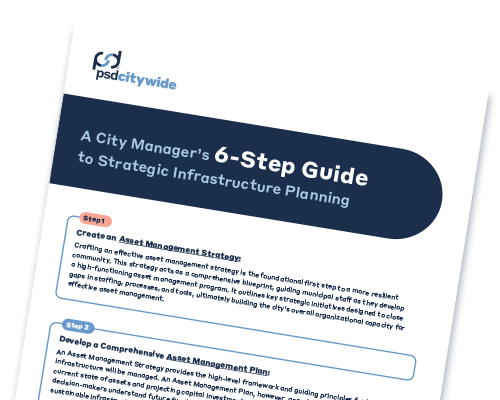
Download our free 6-Step Guide to Strategic Infrastructure Planning