Key Takeaways:
- Who: Public Works and municipal asset management teams
- What: A practical framework for embedding predictive maintenance into daily operations
- Benefit: Reduce reactive work by 20–25%, strengthen capital planning, and build defensible maintenance budgets
Why Does Predictive Maintenance Require Culture, Not Just Technology?
Technology alone doesn’t change behaviour; predictive maintenance works only when supervisors, crews, and leaders build it into everyday routines and decision rules. Many municipalities invest heavily in asset management systems but still rely on:- Staff experience
- Reactive prioritization driven by resident complaints
- Short-term fixes driven by immediate urgency
- Inconsistent inspection practices
How Do Teams Use Asset Data in Daily Work?
Teams turn asset data into daily habits by embedding predictive checks into morning briefings, weekly scheduling, and field inspection practices. Predictive maintenance becomes routine when it’s baked into everyday planning:- Morning Briefings: Supervisors review risk flags or trending condition changes during daily meetings, shaping the day’s work plan.
- Weekly Scheduling: Instead of prioritizing only urgent complaints, schedulers incorporate:
-
- Assets approaching risk thresholds
- Clusters of deterioration visible in GIS
- Recommended interventions based on condition trends
- Field Staff Practices: Simple, repeatable expectations like consistent inspection scoring and photo documentation improve data reliability. Field teams engage more when they see their inputs directly influencing planning.
How Do Decision Rules Make Predictive Maintenance Actionable?
Clear decision rules make predictive maintenance actionable by defining thresholds, triggers, and standard response levels that give field judgment structure and consistency. Dashboards can overwhelm teams without clear guidance. Effective rules include:- Thresholds (e.g., “Pavement Condition Index (PCI) below X enters risk-based maintenance queue”)
- Triggers (e.g., “pump vibration trend increases 15% over baseline triggers inspection”)
- Standard response levels tied to urgency and risk
How Does Predictive Maintenance Support Budget Requests?
Predictive maintenance supports budget requests by providing cost-of-doing-nothing analyses, capital timing evidence, audit trails, and risk-based justifications tied to service levels. Public Works leaders need evidence when requesting funding. Predictive maintenance supports this with:- Cost-of-doing-nothing analyses, showing how deferral increases long-term cost
- Capital timing evidence, using deterioration models
- Clear audit trails demonstrating why certain assets were prioritized
- Risk-based budget requests tied directly to service levels and liability reduction
How Does Predictive Maintenance Connect with Operations, Finance, and GIS?
Predictive maintenance connects with operations, finance, and GIS through integrated EAM/CMMS, finance, SCADA, and capital planning systems that share asset data and trigger automated workflows. A modern predictive maintenance approach needs integration across municipal systems:- Enterprise Asset Management (EAM)/Computerized Maintenance Management System (CMMS) integrated with GIS for spatial deterioration patterns
- EAM/CMMS integrated with Finance to align maintenance activities with budget tracking
- SCADA integrated with CMMS to drive automated triggers for high-risk infrastructure
- Capital planning tools integrated with EAM to merge lifecycle modeling with real-world maintenance data
What Prevents Predictive Maintenance Adoption?
Common adoption blockers include siloed data, inconsistent inspection methods, limited staffing, and worker skepticism—all reduced by starting small and proving value with early wins. Municipalities consistently face similar adoption challenges:- Siloed data between departments
- Inconsistent inspection methods
- Limited staffing capacity
- Worker skepticism about new systems
- Reduced last-minute repairs
- Quicker identification of recurring issues
- Improved clarity around scheduling
What Should Leaders Do First?
Leaders should request predictive insights in meetings, pilot high-value assets first, and track measurable outcomes like fewer reactive work orders and stronger compliance. Leadership influence determines whether dashboards gather dust or predictive maintenance transforms operations. Executives should:- Ask for predictive insights in regular meetings: When leaders expect predictive thinking, staff prioritize it.
- Pilot high-value assets first: Examples: fleet, roads, pump stations, facilities, stormwater culverts.
- Track measurable outcomes: Municipalities often see:
- Fewer reactive work orders
- Stronger compliance reporting
- Fewer service disruptions
- Improved confidence in capital forecasts
How Do Reactive and Predictive Maintenance Compare in Municipal Operations?
Reactive maintenance is complaint-driven, variable, and costly, while predictive maintenance is risk-planned, stable, and saves 20–25% with better council justification and risk control.| Factor | Reactive Maintenance | Predictive Maintenance |
| Workload Stability | Highly variable; driven by complaints | Planned; risk-based |
| Budget Impact | Higher long-term cost | 20–25% savings |
| Staff Time | Frequent emergencies | More scheduled work |
| Council Reporting | Justifies past activity | Justifies future investment |
| Risk Management | High failure likelihood | Failure prevented/anticipated |
| Data Use | Viewed occasionally | Embedded daily |
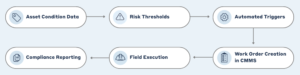
From Predictive Insights to Daily Work Orders Workflow
Key Terms to Know
- Predictive Maintenance: Using condition trends, failure patterns, and lifecycle forecasts to anticipate maintenance needs before failure occurs.
- Condition-Based Maintenance (CBM): Maintenance driven by asset condition instead of fixed schedules.
- Enterprise Asset Management (EAM): Platform used to track the full lifecycle of assets, including registry, maintenance activities, work orders, and condition history.
- Computerized Maintenance Management System (CMMS): Software that automates maintenance work orders, asset tracking, and preventive maintenance schedules.
- Public Works Maintenance Strategy: A coordinated approach to managing municipal infrastructure using data-driven, predictive, and condition-based practices.
About the Author
Christie Wiggers Christie Wiggers is the Director, Implementation Services at PSD Citywide and an experienced leader. She possesses over 17 years of project management, GIS, CMMS, and municipal infrastructure asset management experience. Christie has overseen 65+ EAMS and CMMS implementation projects for PSD Citywide, including complex, multi-year engagements, and is effective at engaging with various levels of municipal stakeholders. Christie is a certified Project Management Professional (PMP) through the Project Management Institute and certified in asset management through the Institute of Asset Management (IAM).